The Best Manufacturing Contacts to Email by Offer Type
 Written by Farhad
Cold emails to manufacturers often get low reply rates because they go to the wrong person. People reach out to a senior title that looks important instead of the person who actually handles the problem.
Most manufacturers split responsibilities across teams like production, engineering, maintenance, procurement, supply chain, quality, safety, and plant technology. If your email lands with someone outside that area, it will usually be ignored.
TLDR
-
Manufacturing cold email works best when you target the people who handle the problem
-
Operations usually owns output, throughput, scheduling, and scrap issues on site
-
Target maintenance for downtime, uptime, and equipment reliability
-
Engineering should be targeted for process changes, automation, and line improvements.
-
Procurement, supply chain, quality, safety, and plant technology should be targeted when the offer matches their ownership
Best roles to target by offer type
| What you are selling | Which decision-makers to target in manufacturing |
|---|---|
| Anything relating to output, throughput, scheduling, scrap reduction, labor efficiency, or daily production performance | Plant Manager, Operations Manager, Production Manager |
| Process improvement, automation, robotics, line redesign, machine vision, or workflow changes | Engineering Manager |
| Downtime reduction, predictive maintenance, spare parts, machine monitoring, or uptime improvement | Maintenance Manager, Reliability Manager, Maintenance Supervisor, Maintenance Director |
| Raw materials, packaging inputs, contract manufacturing services, supplier programs, or cost savings on purchased items | Purchasing Manager, Procurement Manager, Buyer, Sourcing Manager |
| Freight, warehousing, inventory flow, supply continuity, lead time improvement, or broader supply chain tools | Supply Chain Manager, Logistics Manager, Materials Manager, Procurement and Supply Chain Director |
| Inspection systems, traceability, batch records, audit prep, release workflows, or regulated documentation | Quality Manager, Quality Assurance Manager, QA Director, Quality Control Manager, especially in regulated manufacturing |
| Worker safety, ergonomics, heat stress, exposure controls, machine guarding, or compliance support | EHS Manager, Safety Manager, Environmental Health and Safety Director, Occupational Health and Safety Lead |
| Connected machines, plant networks, industrial cybersecurity, remote access, PLC or SCADA security, or OT monitoring | OT Manager, IT and OT Security Lead |
| Big plant-wide initiatives that affect multiple departments and budget owners | Plant Director, VP of Operations, COO |
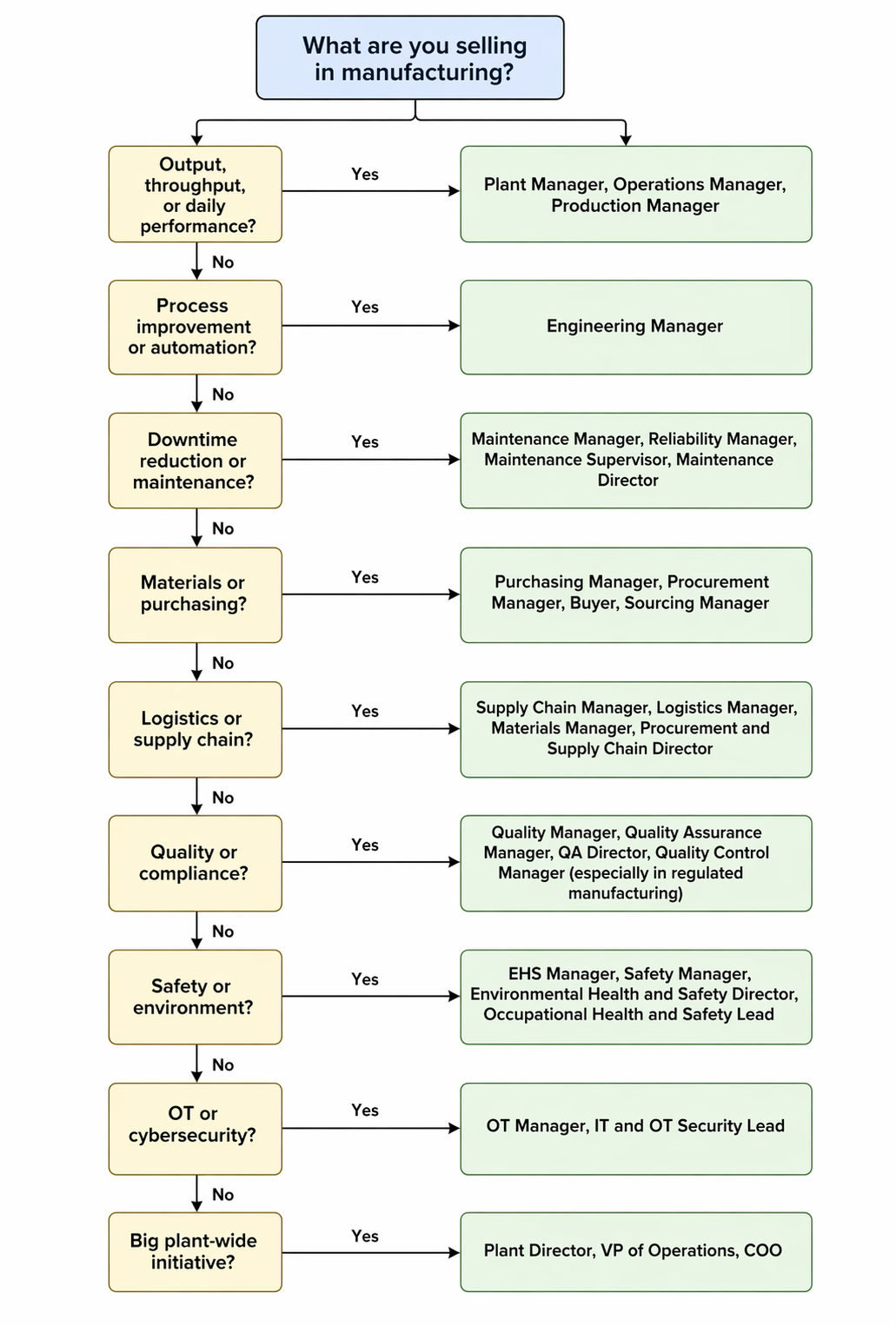
For a simpler version of this table view the decision tree below:
Why Operations Is the Right First Contact for Production Issues
If your offer helps improve throughput, capacity, scheduling, labor efficiency, scrap rates, or on time output, start by reaching the plant manager, operations leader, or production manager. The Bureau of Labor Statistics says industrial production managers oversee plant operations and coordinate, plan, and direct production activity. They keep production on schedule, manage labor and equipment well, monitor results, and deal with problems on the floor. This makes them the best first target for software, equipment, or services tied to line performance.
One example is a company selling software that helps a packaging line switch between jobs faster. Send that email to the plant or operations leader first and not straight to the president or owner. They are the ones who are responsible when production slows down, orders get delayed, and people start working extra overtime. Emails tend to work better when it is clear you understand the person’s schedule, rework, stoppages between runs, and daily production targets, instead of sending vague messages about innovation.
For Downtime and Uptime Problems, Target Maintenance
If what you sell helps prevent breakdowns, keep equipment running, manage spare parts, or catch problems early, maintenance or reliability is the best place to start. The Bureau of Labor Statistics says industrial machinery mechanics and maintenance workers install, maintain, and repair factory equipment and other industrial machinery. That is the group that normally sees breakdowns, recurring failures, and dealing with machinery costs during production.
Let's say you sell condition monitoring sensors for motors and conveyors. A maintenance manager is very likely to respond compared to a general executive about how unplanned downtime is costing production output and rushed repairs. Write the email like you understand plant operations. Mention recurring breakdowns, failures that are easy to miss, and fewer unexpected shutdowns overall. That kind of message has a much better chance of a reply than a generic email about efficiency.
Engineering Owns Process Improvement
An offer about product changes or improvements should target engineering. The Bureau of Labor Statistics notes that manufacturing engineers design or improve manufacturing systems and related processes. That can include automation, layout changes, and process changes meant to reduce costs and improve product quality. If your product changes how the production line runs, whether that is robotics, vision systems, fixtures, or control tools, engineering should usually be one of your first contacts.
A good example is a company selling an automated inspection system that finds defects sooner on a high volume production line. A manufacturing engineer or engineering manager is more likely to care about system fit, cycle time, false fails, line setup, and how it works in production. That is why this usually gets more traction with engineering than with general leadership titles.
Why Procurement Matters for Cost and Vendor Changes
If what you sell affects suppliers, pricing, lead times, service agreements, or buying terms, procurement should usually be one of the first teams you contact. The Bureau of Labor Statistics says buyers and purchasing managers compare suppliers based on price, quality, delivery, and service. That makes them a key group to contact for raw materials, parts, packaging, contract manufacturing, freight services, and sourcing tools.
For example, if you sell packaging that arrives with fewer defects and ships more consistently, operations may care, but procurement is often the team that decides whether it moves ahead. A good procurement email should show that you understand the balance between price, quality, and dependable delivery. If the message only says the product is great, then it doesn’t address their pain point and lowers the chance of a reply.
When to Contact Supply Chain Instead of Procurement
Some manufacturing offers affect both purchasing and plant operations. If you help with incoming materials, inventory flow, supplier issues, or shortage response, don’t only target procurement. Supply chain or materials leaders may matter just as much because they see how shortages, late deliveries, and poor planning affect production. In many plants, the problem shows up as line stoppages, rush orders, and schedule changes across the week. Procurement handles the purchase side, but supply chain deals with the production problems.
For example, a company might sell software that alerts manufacturers sooner when key parts will be delayed. That matters to both procurement and supply chain teams. Procurement is more likely to care about the supplier and the buying terms. Supply chain is more likely to care about whether the plant will end up short on parts. This is a case where reaching out to both teams can improve reply rates because the issue directly impacts both of their areas.
What This Means for Your Outreach
In manufacturing cold email, one of the main objectives is sending the message to the right person. If the issue is tied to production, maintenance, engineering, procurement, supply chain, quality, safety, or plant systems, your email should go to the person who handles that area. That makes the message more relevant and gives you a better chance of getting a real response. When you reach the right person for the problem, your outreach works better, gets more replies, and gives you a better chance of closing more deals.
FAQ
Should I always email the plant manager first?
No. The best first contact depends on what you sell. If your offer helps output, scheduling, or line performance, the plant manager may be the right person. If it is about downtime, quality, safety, procurement, or plant systems, another role may be a better fit. Use the table above to find the best person to contact based on what you are selling.
Can I target multiple roles at the same company?
Yes. In manufacturing, that often works better than relying on one contact. A plant may have different people owning operations, maintenance, engineering, procurement, quality, and safety, so sending to a small group of relevant roles can give you a better shot at reaching the right owner.
What are the biggest mistakes in manufacturing cold email?
The biggest mistake is choosing a title based on seniority instead of ownership. Just because someone has a high title does not mean they are the person dealing with the problem you solve. Your targeting gets much better when you ask who actually feels the pain day to day. Another common mistake is scaling outreach before cleaning a list of contacts, so it also helps to run these list hygiene checks before sending at scale.
Newsletter
Get B2B insights delivered to your inbox
Practical marketing and sales insights for B2B growth teams. No spam — we promise.
Related articles

Average B2B Contact Data Accuracy Rate: Vendor Claims vs. Reality
Most B2B data providers advertise 90%+ accuracy. Independent testing tells a different story. See the real gap between claimed and actual contact data accuracy.

What Percentage of B2B Email Opens Are Actually Fake
Apple's Mail Privacy Protection auto-opens emails for millions of inboxes. See how much of your B2B open rate is fake and what to track instead.

How Many Spam Traps Are Hiding in Your B2B Email List
Spam traps make up a tiny share of any list, but even one hit can wreck your sender reputation. See the real spam trap rate and how to avoid them.
