What Makes a Law Firm Contact List Useful?
 Written by Farhad
A law contact list is only useful if the data is accurate and the contacts match your target market. Whether you are running broad outreach or account-based campaigns, the quality of the list affects deliverability, relevance, and response rates.
In legal outreach, that means more than having names and email addresses. A useful list should include the right people, firm details, and contact fields, and a process for keeping the data updated.
TLDR
-
A law firm list is useful when the contact still works at the firm, the email is valid, the title is valid, and the role matches what you sell.
-
First name and email are the minimum fields needed for outreach, but LinkedIn, phone, and location can improve reach and make follow-up easier.
-
Legal contact data changes often, so outdated lists lead to more bounces, worse targeting, and lower campaign performance.
-
The right list depends on the campaign. Broad outreach needs coverage and deliverability, while ABM needs tighter targeting and more personalized data.
Accuracy Comes First
An accurate list means the person still works at the firm, their email is valid, their title is up to date, and their role is close enough to the problem you solve that your outreach feels relevant. It also means they have a real connection to that area, whether they are the decision-maker or directly involved.
At the most basic level, those are the factors that matter most. You may also target firms by size, whether by revenue, headcount, or attorney count, because company size often shapes who owns the decision.
For example, smaller law firms are often a good fit for email marketing services because many are run by a solo attorney or a very small team, which usually means the owner is also the one making marketing decisions. One recent ABA benchmark found that 18% of lawyers surveyed were at solo firms and 33% were at firms with 2 to 9 attorneys; within those groups, 97% of solos and 90% of small firms said they make their own tech decisions.
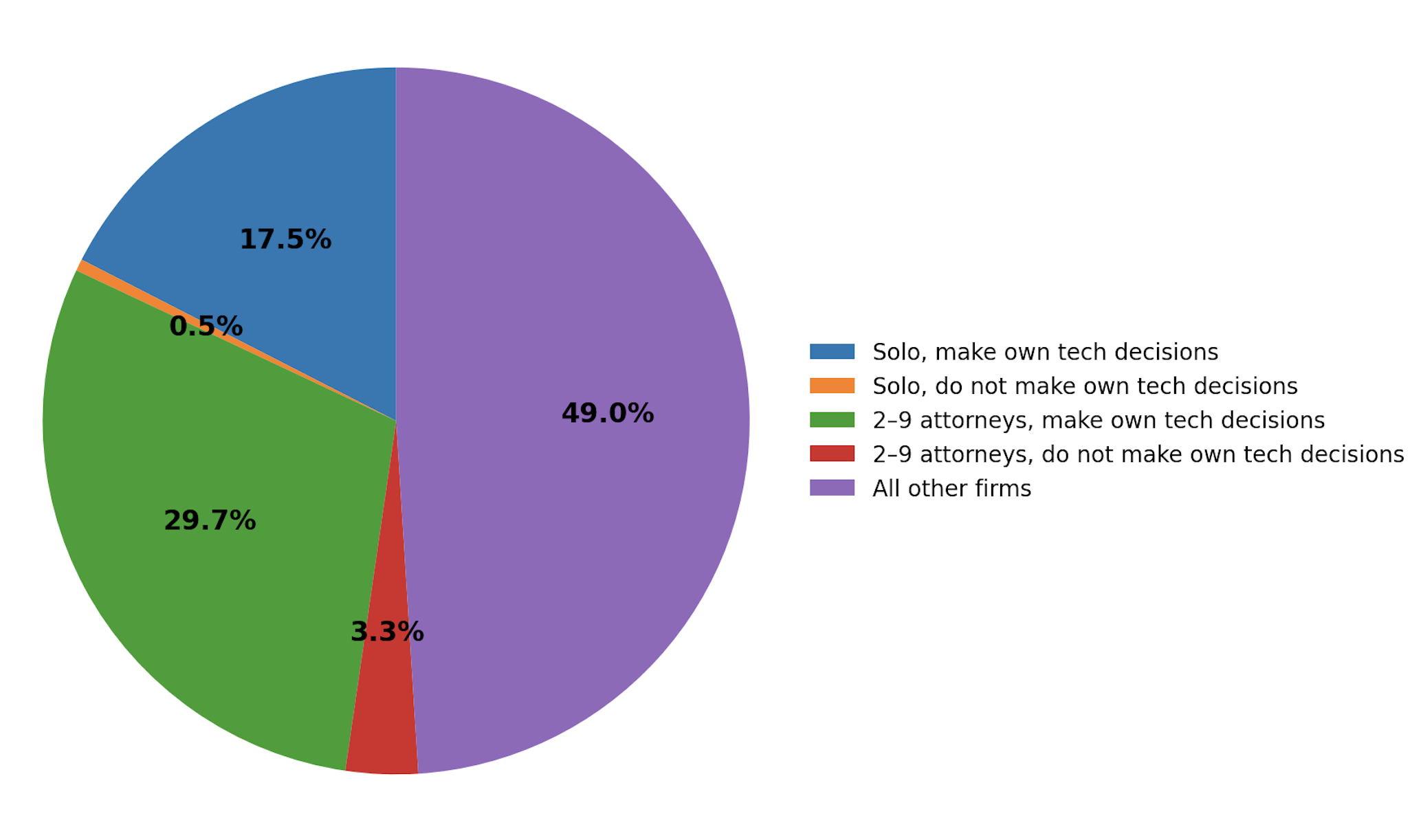
That is much more centralized than the broader B2B market, where buying decisions are usually made by a group rather than a single person. In many cases, that means involving roughly 6 to 10 stakeholders.
What Fields Matter Most
Once a law firm list has been built around your targeting criteria, whether that is revenue, location, firm type, title, or something else, the most essential fields for outreach are first name and email. Those are the basics needed to run email campaigns effectively.
Many lists stop there, but the most useful ones include additional channels that improve your chances of reaching a prospect if email alone does not work. Helpful additions include a personal LinkedIn profile, office phone, mobile number when requested, and company location, which can also support retargeting through online banner ads.
According to an ABA survey, 76% of law firms use LinkedIn as a marketing tool, which suggests that lawyers do spend meaningful time on the platform. More broadly, 87% of B2B marketers use LinkedIn, so legal is not the heaviest-using segment.
LinkedIn still matters in legal outreach not because lawyers use it more than everyone else, but because attorney profiles often reveal firm moves, title changes, office location, and practice focus. That makes the platform especially valuable for keeping legal contact data accurate and useful.
| Channel | Use in outreach | Why it helps |
|---|---|---|
First name + email | Core campaign fields | These are the basic fields needed to run email outreach effectively. |
Personal LinkedIn | Secondary channel and validation layer | Useful when email alone does not work. Attorney profiles can also show firm moves, title changes, office location, and practice focus. |
Office phone | Phone follow-up | Adds another way to reach a prospect when email response is weak or timing is poor. |
Mobile number | Direct follow-up when requested | Helpful for faster, more direct contact when that field is specifically needed. |
Company location | Targeting and retargeting support | Adds geographic context and can support online banner ad retargeting. |
Fresh Data Matters
Contact data decays very fast, with lists often decaying by about 25% per year if they are not actively maintained. People change firms, earn new titles, relocate, or leave the market altogether, which is why buying a fresh list and keeping it updated matters.
There is no published decay rate specifically for legal contacts, but the available hiring data points in the same direction. NALP reported that lateral hiring at law firms rose by nearly 14% overall in 2024, with lateral associate hiring up almost 25%, and MLA Global reported a 15% overall increase in lateral hiring in 2025.
Those figures are not decay-rate statistics on their own, but they do reinforce the idea that attorney and law firm contact data changes often enough to require regular refreshes. In other words, legal contact lists are not something you can buy once and rely on indefinitely.
When buying a law firm list, it is usually better to avoid instant downloadable files. Those lists are often static, and in many cases they include older contacts that have not been recently refreshed.
A high-quality list is rarely available for immediate download and often takes a few days to assemble. That extra step can help protect your sender reputation by lowering the risk of bounced emails and poor targeting.
If you buy lists from multiple providers, keep track of the source for each contact so you can measure deliverability by provider over time. It is also important to maintain a clean, permanent suppression list so anyone who bounced, opted out, or asked not to be contacted does not get reintroduced into future campaigns.
How to Use the List for Broad Outreach
If your campaign is meant to reach thousands of contacts, you are likely targeting a broad share of law firms rather than using the tighter segmentation typical of account-based marketing. Because the message needs to work across much of the legal industry, it should speak to pain points that are widely relevant across firms.
For example, insurance providers often market to law firms of many sizes and in many regions across the United States when promoting business insurance policies. Alongside these broader messages, signup forms are often effective because they allow law firm owners and other decision-makers to respond directly through the system.
Gong analyzed 304,174 general sales emails and found that, in cold outreach, interest-based calls to action performed best. For businesses such as insurance providers, using that kind of CTA can be more effective than sending a broad message with no clear next step.
When sending to a large number of accounts, execution matters just as much as messaging. It is important to warm up your email domain, use drip marketing thoughtfully if sending to a large pool, and closely monitor your sender reputation.
How to Use the List for ABM
If your campaign is aimed at specific buying groups within law firms, or you want messaging tailored to particular practice areas, account-based marketing works well. In this context, ABM means identifying a relevant trigger for the buying group you want to reach and shaping the message around their specific priorities.
Targeting by firm type is especially common because different practice areas tend to face different pain points. For example, an eDiscovery vendor may focus on litigation-heavy firms, since those firms often manage large volumes of data.
The key to ABM is sending personalized messages that offer clear value. Lawyers are more likely to engage when they feel understood as experts and when the message speaks to a real challenge, rather than opening with a generic request for a sales call.
For an eDiscovery audience, that message should be framed around an operational or case-related risk the firm is already feeling. At firms with unpredictable caseloads or multiple active matters, for instance, you might focus on how their team handles sudden data spikes across ongoing litigation.
From there, the outreach can invite a practical conversation. You might ask how they currently manage those surges and whether it would be useful to have a brief discussion about the challenges those spikes create.
Key Takeaways
A legal contact list works when it helps you reach the right people with the right message. Accuracy, useful fields, and regular updates matter more than list size.
The best list for your campaign depends on how you plan to use it. If your goal is scale, you need broad coverage and solid deliverability. If your goal is ABM, you need tighter targeting and better personalization. In both cases, strong data is a key foundation.
FAQ
What makes a law firm contact list accurate?
A law firm list is accurate when the attorney still works at the firm, the email is valid, the title is valid, and the role is relevant to what you sell. It also needs regular refreshes, since business data decays over time and outdated contacts can lead to a lower ROI.
Who should you target in a construction email campaign?
First name and email are the core fields needed for outreach. LinkedIn, phone, location, firm size, and practice area make the list more useful for segmentation, follow-up, and account-based marketing.
How often should you refresh a legal contact list?
You should refresh a legal contact list before major campaigns and recheck older contacts on a regular schedule. In practice, that means following the same kind of list hygiene checks before sending at scale, including deduping and contact suppression.
Newsletter
Get B2B insights delivered to your inbox
Practical marketing and sales insights for B2B growth teams. No spam — we promise.
Related articles

Average B2B Contact Data Accuracy Rate: Vendor Claims vs. Reality
Most B2B data providers advertise 90%+ accuracy. Independent testing tells a different story. See the real gap between claimed and actual contact data accuracy.
What Percentage of B2B Email Opens Are Actually Fake
Apple's Mail Privacy Protection auto-opens emails for millions of inboxes. See how much of your B2B open rate is fake and what to track instead.

How Many Spam Traps Are Hiding in Your B2B Email List
Spam traps make up a tiny share of any list, but even one hit can wreck your sender reputation. See the real spam trap rate and how to avoid them.
