Why Construction Email Campaigns Fail and What Most Marketers Get Wrong
 Written by Farhad
Email marketing to construction companies often fails for a few common reasons. A lot of campaigns are too broad in their messaging, reach the wrong contact, treat construction as a national market, or don’t determine how workload and seasonal cycles affect when decision makers are open to a sales conversation.
Construction companies operate differently from most industries, so your outreach needs to match how contractors actually run their businesses if you want stronger response rates.
TLDR
-
A lot of construction emails sound too polished and generic instead of written for people handling bids, crews, subcontractors, schedules, and active jobs every day
-
Many campaigns miss the right contact because the actual buyer depends on both what you sell and how the contractor is structured internally
-
Construction should not be seen as a national market because local offices, branch locations, and trade firms often matter more than headquarters.
-
Timing matters because weather, current workload, labor shortages, and project cycles all shape when construction decision makers are likely to respond
-
Good construction outreach is targeted, reaches the proper decision maker, fits the local market, and arrives when the company is likely to engage in conversation
Mistake 1: You sound like a marketer instead of someone who understands construction work
When you email decision-makers in construction, sounding like a marketer usually means your message feels like it was written for a broad business audience rather than for people managing bids, schedules, labor, subcontractors, and active jobs that change constantly from one day to the next. Construction managers and company leaders plan, coordinate, budget, and oversee projects, while cost estimators focus on the labor, materials, time, and dollars required to price each job accurately.
Labor shortages are also still delaying projects across the construction industry. Because of that, an email about growth, better operations, or greater efficiency feels off if it doesn’t clearly connect to the way construction companies run their day to day operations.
A weak email to a construction decision maker might say something like, “we help construction firms work efficiently and perform better across the business”. This sounds very clean and doesn't sound like it was written by someone who knows construction. A better version would be, “we help commercial roofing estimators turn around bids faster when requests come in at once”, or “we help general contractors keep subcontractor follow-up from delaying active jobs”.
These examples work better because they reflect actual construction pain points rather than general statements. When you address real pain points and do not sound like a generic marketer, you are far more likely to get replies.
Mistake 2: Contacting the wrong person
Another common mistake is emailing the wrong contact and assuming construction companies make decisions the same way. Who the main buyer is in construction depends on what you sell and which type of contractor you are targeting.
This industry also includes a very large number of small businesses, which means job titles are often less formal than in other industries and the owner is not always the only relevant contact. That’s why a campaign focused only on owners or built around one preferred title usually misses the actual buyer or the person dealing with the issue first.
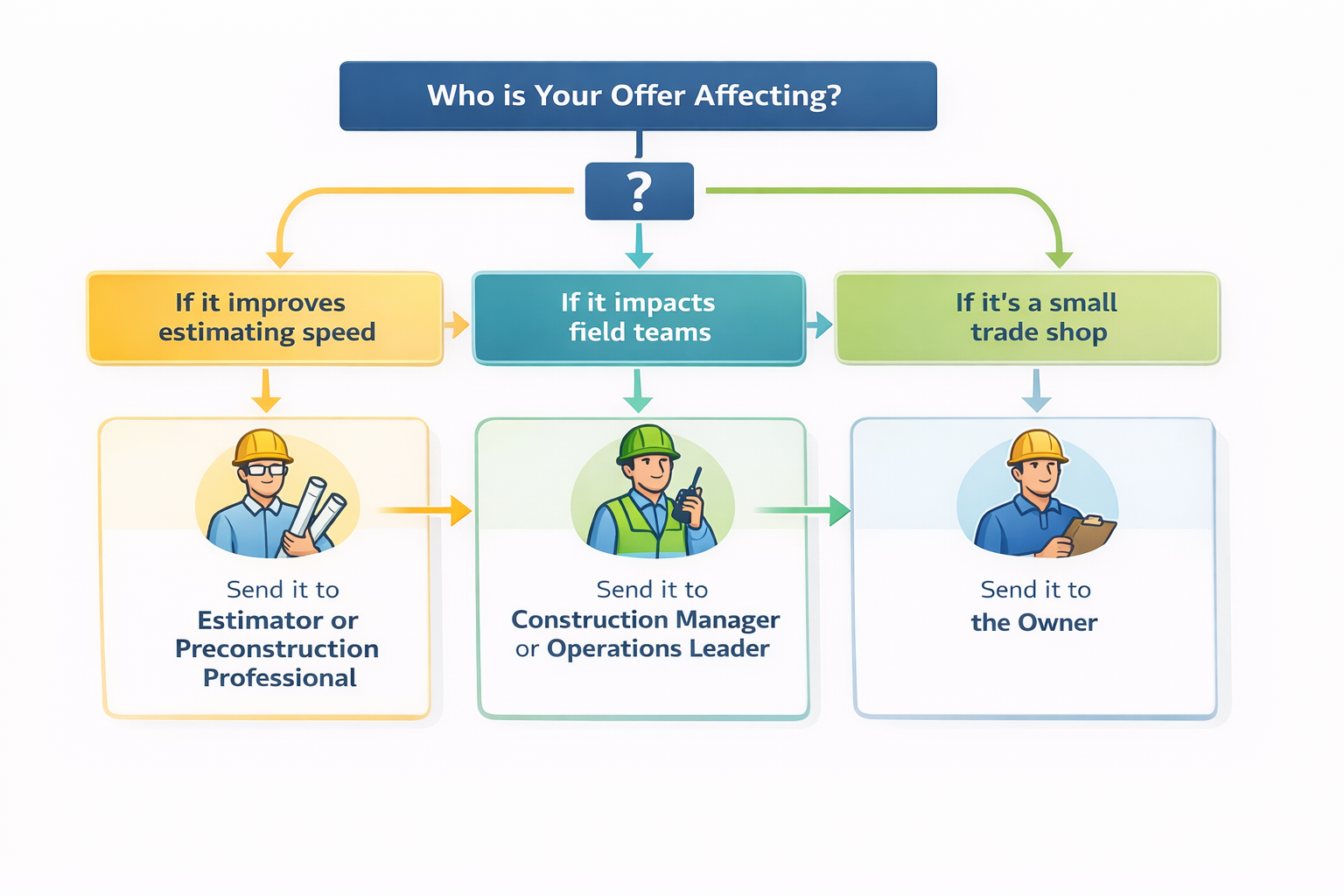
This matters because construction decisions are usually tied to what is happening on active jobs or in the field office today. If your offer affects estimating speed, send it to estimators or professionals working in preconstruction. If you sell something that affects field teams, subcontractor coordination, delivery schedules, or project execution, a construction manager or operations leader may be the better contact. If you sell to a smaller trade shop, the owner may still be right, but only when the message clearly reflects the daily pressure that person is managing there. When the right contact matches the actual problem, the email feels more relevant.
Mistake 3: Treating Construction as one national market
A common mistake in construction email marketing is treating the industry as one national market and assuming one head office contact is enough. The Census Bureau describes a construction establishment as a lasting office or other business location that oversees more than one project or job, and includes examples like a contractor’s main office or branch office, even when that office is based in a home, as well as the office or shop of a specialty trade contractor. That matters because many construction companies work through local offices, branch locations, or trade shops, so a broad national campaign can miss the specific office that actually handles the work daily in that area.
The problem gets worse when the list targets a parent company even though the actual work is handled closer to the field. The Census Bureau also says that single project site offices are not treated as construction establishments and instead the real business is with ongoing offices that oversee multiple jobs instead of one short term location.
In practice, construction outreach tends to work better when you target the right branch, local office, or specialty trade location in the market you want instead of targeting a decision maker at the headquarters or a national level office.
Mistake 4: Disregarding seasonality trends
The final common mistake is treating every month the same in construction. Construction work shifts with weather and project schedules, and in the northern U.S markets, winter weather can slow jobs, while construction hiring and overall activity usually increase during the spring and summer months each year. That means reaching the same company can be far more difficult when crews are on jobsites, work is moving quickly, and managers are dealing with issues all day long. If you send the same kind of outreach at the same cadence all year, you can easily hit people at the worst possible time and mistake bad timing for bad fit.
A better approach is to align the outreach to how construction companies really operate through the year in their market. A roofing company in a northern state, a civil contractor, and a heating and air conditioning service firm do not face the same pressures at the same time, so late winter and fall are often better times to market than peak spring and summer work season, when weather and workload keep the team busy.
Labor shortages can make busy project periods more hectic because delays and understaffing can pull attention away from email and following up. AGC found labor shortages still drive many project delays with 45% of firms reporting delays tied to shortages of their own workers or subcontractors' workers. So the mistake is not only emailing at the wrong time of year, but emailing as though seasonality, workload, and jobsite pressure do not affect when owners, estimators, project managers, and operations leaders are truly open to a sales conversation.
Key Takeaways
Construction email marketing works better when it reflects how construction companies actually operate. That means writing in a way that sounds grounded in the industry, reaching the person who is most likely to care about the problem, targeting the right local office or branch instead of treating every company like one national market, and paying attention to seasonality, workload, and field pressure. When the outreach feels specific to the trade you’re targeting and the daily reality of the people receiving it, it has a much better chance of getting read and getting replies.
FAQ
Why do construction cold emails fail even when the offer is good? They usually fail because the message is too generic, the contact is not close to the problem, or the data is outdated. Since B2B contact data decays over time, even a strong offer can miss if it reaches the wrong person or an outdated record.
Should you target the headquarters or the local branch in construction outreach? Usually the local branch, office, or trade location is better when that is the team handling the work in that market. Construction companies often operate through multiple offices, so a national contact does not always map to the people dealing with estimating, field issues, or scheduling locally.
How do you avoid emailing the wrong person at a construction company? Match the contact to the problem you solve, not just the top title. That is the same reason human-verified leads matter, because verified roles make it easier to reach the person actually tied to the issue instead of sending to a generic or outdated contact.
Newsletter
Get B2B insights delivered to your inbox
Practical marketing and sales insights for B2B growth teams. No spam — we promise.
Related articles

Average B2B Contact Data Accuracy Rate: Vendor Claims vs. Reality
Most B2B data providers advertise 90%+ accuracy. Independent testing tells a different story. See the real gap between claimed and actual contact data accuracy.

What Percentage of B2B Email Opens Are Actually Fake
Apple's Mail Privacy Protection auto-opens emails for millions of inboxes. See how much of your B2B open rate is fake and what to track instead.

How Many Spam Traps Are Hiding in Your B2B Email List
Spam traps make up a tiny share of any list, but even one hit can wreck your sender reputation. See the real spam trap rate and how to avoid them.
